
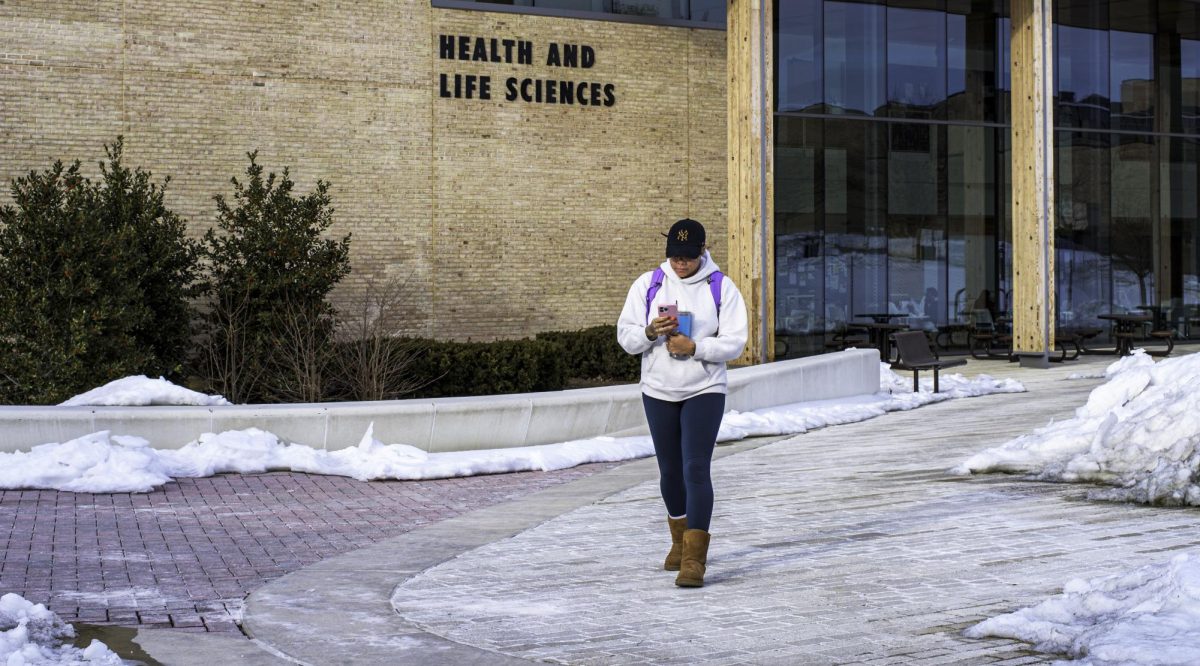
The snowstorm that closed campus for five days during the second week of school left behind a thick layer of ice that took the college’s maintenance staff five days to scratch through and remove in freezing temperatures.
James Taylor, AACC’s executive director of administrative services, said he has never seen a storm that caused this much disruption, citing the thick layer of ice on top of the snow as the main reason for the prolonged closure.
“This was really a doozy, this one, and it was mainly the ice,” Taylor said. “With this one, we had to break through the ice to get to the snow, to remove the snow.”
The decision to cancel in-person classes and close the campus fell on AACC Vice President for Learning Resources Management Melissa Beardmore and took into account the condition of parking lots, streets and sidewalks on campus, weather forecasts and whether nearby roads had been cleared.
“It’s a lonely decision, I’ll tell you that,” Beardmore said. “But I will always, like we did during COVID, always err on the side of caution.” This time, she said, “I was on the side of safety.”
Taylor said his crew, made up of AACC employees, worked as quickly as possible.
“I don’t think we could have done it much quicker than we did,” Taylor said. “You could clear a lot down to the ice. You could salt a lot that had ice on it, but the temperatures were so low that the ice then, or the salt wasn’t working. … So there were days early on where we didn’t have any sun. That didn’t help at all, right? And it was really, really cold.”
During the five-day campus closure, in-person classes were canceled, but professors who teach online still held class. Some instructors temporarily converted their face-to-face classes to Zoom.
“It did affect my, like, processing for anatomy and physiology,” Michaela West, a first-year nursing student, said. “It would have really helped to be in front of my teacher instead of, you know, on Zoom or just teaching myself through the videos.”
For first-year chemistry student Diana Cruz, the storm meant more work than usual.
“They gave a lot of online assignments to do, and I had like six to do on, like, one single day,” said Cruz, whose professors assigned homework instead of holding classes online.
Most of media production student Mark Felarca’s professors used email to assign readings and posted discussion questions on Canvas.
“We were able to do it on our phones or on computers,” Felarca said. “So it’s really simple. … Other than that, I think the professors, at least my professors, handled it really well. They were able to just be on the ball.”